Soc. 920:298:H1 Honors Seminar: Work, Family, and Politics in the 21st Century
Spring, 2006
Monday & Thursdays 10:20-11:40 a.m.
Lucy Stone B205, Livingston Campus
Contact information:
Rutgers University
Department of Sociology
Office: Rm. A-342, Lucy Stone Hall (Livingston campus); phone: (732) 445-5848
Office hrs: Mondays and Thursdays, 12 to 1 p.m. (or by appointment)
Email: roos@rutgers.edu
I. Course Description:
Work and family issues have in recent years become inextricably linked to politics, for better or for worse. To better understand that link in the 21st century, we review the historical shifts that have occurred in the family and the workplace in the post-World War II U.S., and especially since 1970. Women now make up nearly half of the workforce, and have moved in large numbers into some occupations traditionally held by men. Dual-earner households are now the norm, reflecting in part the new economic reality faced by American families. Work has restructured such that it is more international, flexible, high tech, and service-oriented, and prosperity now coexists with rising inequalities. We will examine how such structural changes impact ongoing politics, policy discussions, civic engagement, and the economic and social opportunities available to women, men, and their families.
There are no prerequisites for this course. Although many of the readings come from a variety of disciplines (e.g., sociology, history, psychology, policy studies), an important goal of this course is to introduce you to the sociological perspective, and the sociological imagination.
II. Readings:
There are six required books. In addition, I will make additional readings
available online (see below). The required books (most of which are available
at the Livingston College Bookstore) are:
New York Times. 2005. Class Matters. New York: Times Books. Henry Holt and Company.
Elaine Tyler May. 1990. Homeward Bound: American Families in the Cold War Era. New York: Basic Books.
Beth Shulman. 2005. The Betrayal of Work: How Low-Wage Jobs Fail 30 Million Americans. New York: The New Press.
Barbara Ehrenreich. 2005. Bait and Switch: The (Futile) Pursuit of the American Dream. New York: Metropolitan Books, Henry Holt and Company.
Mary Blair-Loy. 2005. Competing Devotions: Career and Family Among Women Executives. Cambridge, MA: Harvard University Press.
Buy EITHER Clinton OR Santorum through Amazon or other online vendors (we'll decide in class who buys which):
Hillary Rodham Clinton. 1996. It Takes a Village: And Other Lessons Children Teach Us. New York: Simon and Schuster.
Rick Santorum. 2005. It Takes a Family: Conservatism and the Common Good. Wilmington, DE: ISI Books.
III. Expectations:
This is an honors seminar, so I have high expectations of you. I anticipate that you will attend each class session. Because this course is a "seminar" and not a "lecture" course, there will be less lecturing, and more discussion. The success of the course depends on your active participation, and the small class size should facilitate this goal. Assigned readings should be completed prior to class meetings, and you should come to class prepared to ask questions. If you absolutely must miss class, please let me know as soon as possible.
I've assigned both academic articles, and media (newspaper, magazine) articles, the latter of which tend to be quite short. To keep the number of readings down to a reasonable number, I've moved some of the readings to "recommended." While these articles or books are not required, I nonetheless do recommend them to you if you'd like to do extended reading on the topic, or use them for your short paper (or final) papers. I will continue to add relevant articles as I come across them.
Grades will be based on:
1) Class participation/attendance, including written commentary (QIPS, 20 percent total)
To enhance class discussion, please come to each class with QIPs, a 4x6 index card on which you have written a Question, Interest, or Problem from that day's readings. Pick out something that interests you, and respond to it in a "stream of consciousness" paragraph. We'll use these to structure the day's discussion. Each student will also be asked to facilitate class discussion several times during the semester, so the QIPs will be useful in preparing for this. [Thanks to Professors Ann Mische and Arlene Stein, who suggested this technique to me.]
No QIPs are required on days you have written assignments due. Since they
also indicate attendance, they should be turned in at the beginning of class
(don't forget to keep a copy for yourself). I'll grade these as either  (which
indicates satisfactory work) or
(which
indicates satisfactory work) or  +
(which indicates exceptional work). I will give a "-" for a
missed class, a missed QIP, or an unacceptable QIP. Because difficult times
happen to all of us, you are permitted two "-" grades with no questions
asked.
+
(which indicates exceptional work). I will give a "-" for a
missed class, a missed QIP, or an unacceptable QIP. Because difficult times
happen to all of us, you are permitted two "-" grades with no questions
asked.
2) Several short papers (double-spaced, 3-4 pp. max.; 20 percent total)
Throughout the semester, you will write several short papers, responding to readings and class discussions. I will give you more specific directions in class, but the (tentative) general topics of these short papers, and their due dates, are:
Short paper #1 (due Jan. 26; 5 percent): Access the class graphic web page (see week 1), and figure out the class status of your family of origin. Access the political typology web page (see week 1), and figure out your personal political typology. Describe your findings. How are your class of origin and political typology related, or are they? Take a stand, make an argument, and justify it.
Short paper #2 (due Feb. 2; 5 percent): Focus in on one or two of Elaine Tyler May's arguments re American families in the Cold War Era. Bring her arguments up to date: are they relevant for 21st century America? Take a stand, make an argument, and justify it.
Short paper #3 (due March 23; 10 percent): In preparation for our in-class mini-debate, critically analyze the two "opt-out" arguments, by Linda Hirshman and David Brooks. Feel free to supplement with other authors. Who is right? Take a stand, make an argument, and justify it.
3) Analytic review and debate (double-spaced, 4-5 pp. max; due April 6; 20 percent)
On April 6, we will have an in-class debate on the appropriate role of government in family policy. You will read either Clinton's or Santorum's book, write an analytic critique of the book you choose, and use the book's viewpoint as the basis for your arguments during the debate. Thus, you will critique the book in your analytic review, and argue for its viewpoint in the debate. For advice on how to write an analytic review, see Clarke's "On Writing and Criticism."
4) Final research paper (double-spaced, approx. 15 pp. with a minimum of 7 to 10 academic references) on a topic of your choice (40 percent).
Note: this can be an outgrowth of one of your short papers, or the debate topic. A written description of your paper topic with 2-3 annotated references is due Feb. 23rd. Clear your topic with me ahead of time. First draft due April 27th, final draft due May 4th. Use primarily academic references for this paper! It's okay to supplement with excellent articles from reputable media sources (e.g., Fortune, the New York Times), but these should be few in number in comparison with academic references.
Each student will also present a brief summary of her or his paper during one of the last three class sessions (April 24, April 27, or May 1). Prepare a few power point slides to accompany your presentation.
Summary of due dates:
January 26: Short paper #1
February 2: Short paper #2
February 23: Description of paper topic, with 2-3 annotated references
March 23: Short paper #3
April 6: Analytic review and debate preparation due
April 24, April 27, or May 1: Class presentation with power point slides
April 27: First draft of final paper due
May 4: Final draft of paper due
IV. Academic Integrity:
This course will be conducted in full accordance with the university's "Policy on Academic Integrity." Academic dishonesty includes (but is not limited to) quoting or paraphrasing without attribution; submitting work for more than one course without the instructor's permission; copying from, or assisting, other students on exams; plagiarizing major portions of assignments; using a purchased paper; presenting other's work as your own; altering a graded exam; theft of exams. [For the complete policy, click here.]
Note: it is very easy to cut and paste from the internet, and/or copy verbatim selections from articles or books. This is called plagiarism. It's also pretty easy to find plagiarism nowadays. You can use internet sources (preferably academic sources you find online through IRIS), as well as print sources, but paraphrase the work you use and properly cite it. Avoid over-quoting, but if you do use an author's exact words you must put them in quotes and cite.
I will not accept any assignments or papers from students involved in dishonest behavior, and I am required to report such students to their college dean. Students engaging in dishonest behavior hurt all students. As the Policy on Academic Integrity states: "Students are responsible for knowing what the standards [for academic integrity] are and for adhering to them. Students should also bring any violations of which they are aware to the attention of their instructors."
V. Course Outline:
Part I: Overview and History
Week 1 (Jan. 19): Introduction and Course Overview: Politics and the Family
Hillary Clinton, It Takes a Village, Ch. 1
Rick Santorum, It Takes a Family, Ch. 1
http://www.nytimes.com/packages/html/national/20050515_CLASS_GRAPHIC/index_01.html
[check the class status of your family of origin]
http://typology.people-press.org/ [check your personal political typology]
Recommended:
The Pew Research Center for the People & the Press. 2005. "Beyond
Red vs. Blue: Republicans Divided About the Role of Government, Democrats
by Social and Personal Values." Washington, D.C., May 10. (pp. 1-51)
( http://people-press.org/reports/display.php3?ReportID=242)
Week 2 (Jan. 23-26): Real People, Real Lives: Work, Class, and the American Dream
New York Times. 2005. Class Matters. New York: Times Books. Henry Holt and Company.
Week 3 (Jan. 30-Feb. 2): Family and Politics: WWII and Postwar Era
http://www.thestatenislandboys.com/U_thrill_me/index.htm [click for 1950s and 1960s nostalgia]
Elaine Tyler May. 1990. Homeward Bound: American Families in the Cold War Era. New York: Basic Books. (Chs. Intro-3; Chs. 4, 6, 9, postscript)
Joanne Meyerowitz (ed.). 1994. Not June Cleaver: Women and Gender in Postwar America, 1945-1960. Philadelphia, PA: Temple University Press. (skim pp. 1-16, 229-262 to understand her critique)
Part II: It's Not the 1950s Anymore: Changing Demographics
and Economic Transitions
Week 4 (Feb. 6-9): Demographic Overview: Women, Men, and the Family
Phyllis Moen and Patricia Roehling. 2005. The Career Mystique: Cracks in the American Dream. New York: Rowman & Littlefield Publishers. (Ch. 1 only)
Robert Orrange. Aspiring Professionals Define Work, Family, and Leisure: Life Politics at the Dawn of Risk Society. Unpublished book. (Chs. 2-3)
Elizabeth Warren. 2006. The Middle Class on the Precipice: Rising Financial Risks for American Families." Harvard Magazine, January-February.
Barbara Reskin and Patricia Roos. 1990. Job Queues, Gender Queues: Explaining Inroads into Male Occupations. Philadelphia, PA: Temple University Press. (Chapter 1, Chapter 3; Recommended: Chapter 2)
Mary Gatta and Patricia Roos. 2005. "Rethinking Occupational Integration." Sociological Forum 20:369-402.
Recommended:
Donald Hernandez. 2005. "Changes in the Demographics of Families over the Course of American History." Pp. 13-35 in Jody Heymann and Christopher Beem (eds.), Unfinished Work: Building Equality and Democracy in an Era of Working Families. New York: New Press.
Eileen Boris. 2005. "Changing Work and Family Lives: A Historical Perspective." Pp. 36-62 in Jody Heymann and Christopher Beem (eds.), Unfinished Work: Building Equality and Democracy in an Era of Working Families. New York: New Press.
Week 5 (Feb. 13-16): Economic Transitions: Overview
Thomas Friedman. 2005. "It's a Flat World After All." New York Times, April 3.
Annette Bernhardt, Martina Morris, Mark S. Handcock, and Marc A. Scott. 2001. Divergent Paths: Economic Mobility in the New American Labor Market. New York: Russell Sage Foundation. (Ch. 1)
Vicki Smith. 1997. "New Forms of Work Organization. Annual Review of Sociology 23:315-39.
Paul DiMaggio. 2001. The Twenty-First-Century Firm. Princeton: Princeton University Press. (Ch. 1)
Arne Kalleberg, Barbara F. Reskin, and Ken Hudson. 2000. "Bad Jobs in America: Standard and Nonstandard Employment Relations and Job Quality in the United States." American Sociological Review 65:256-278.
Recommended:
Arne Kalleberg. 2000. "Nonstandard Employment Relations: Part-Time, Temporary, and Contract Work." Annual Review of Sociology 26:341-65.
Christopher Jencks. 2004. "The Low-Wage Puzzle: Why is America Generating So Many Bad Jobs--and How Can We Create More Good Jobs?" The American Prospect. January 1, 2004. [see also related articles from a Russell Sage Foundation report]
Harriet B. Presser. 2006. "Toward a 24 Hour Economy: The U.S. Experience and Implications for the Family." Pp. 459-65 in Amy S. Wharton (ed.), Working in America: Continuity, Conflict, and Change. New York: McGraw Hill.
Jerry A. Jacobs and Kathleen Gerson, with Janet C. Gornick. 2004. "American Workers in Cross-National Perspective." Pp. 119-47 in Jerry A. Jacobs and Kathleen Gerson (eds.), The Time Divide: Work, Family, and Gender Inequality. Cambridge, MA: Harvard University Press.
Paul Krugman. 2002. "For Richer: How the Permissive Capitalism of the Boom Destroyed American Equality." New York Times, October 20.
Paula England and Nancy Folbre. 2006. "Capitalism and the Erosion of Care." Pp. 496-510 in Amy S. Wharton (ed.), Working in America: Continuity, Conflict, and Change. Third edition. New York: McGraw Hill.
Barry Bluestone and Stephen Rose. 1997. "Overworked and Underemployed: Unraveling an Economic Enigma." The American Prospect 8:March 1-April 1.
Week 6 (Feb. 20-23): Economic Transitions: Blue-Collar Work
Beth Shulman. 2005. The Betrayal of Work: How Low-Wage Jobs Fail 30 Million Americans. New York: The New Press.
Matt Bai, 2005. "New World Economy." New York Times, December 18.
Wal-Mart Stores. 2005. "Board of Directors FY06: Benefits Strategy." (skim)
Recommended:
Charles Fishman, The Wal-Mart Effect (WNYC, Leonard Lopate Show, 33 min.)
Week 7 (Feb. 27-Mar. 2): Economic Transitions: White-Collar Work
Barbara Ehrenreich. 2005. Bait and Switch: The (Futile) Pursuit of the American Dream. New York: Metropolitan Books, Henry Holt and Company.
Vicki Smith. 2001. Crossing the Great Divide: Worker Risk and Opportunity in the New Economy. Ithaca: Cornell University Press. (Ch. 5)
Part III. Accommodating Work and Family
Week 8 (Mar. 6-9): Cultural or Institutional?
Mary Blair-Loy. 2005. Competing Devotions: Career and Family Among Women Executives. Cambridge, MA: Harvard University Press.
Joan Williams. 2001. Unbending Gender: Why Family and Work Conflict and What To Do About It. New York: Oxford University Press. (Intro & Ch. 1)
Recommended:
Suzanne M. Bianchi. 2000. "Maternal Employment and Time with Children: Dramatic Change or Surprising Continuity?" Demography 37:401-414.
Lynette Clemetson. 2006. "Work vs. Family, Complicated by Race." New York Times, February 9.
Eduardo Porter. 2006. "Stretched to Limit, Women Stall March to Work." New York Times, March 2.
March 13-17th: Spring Break!
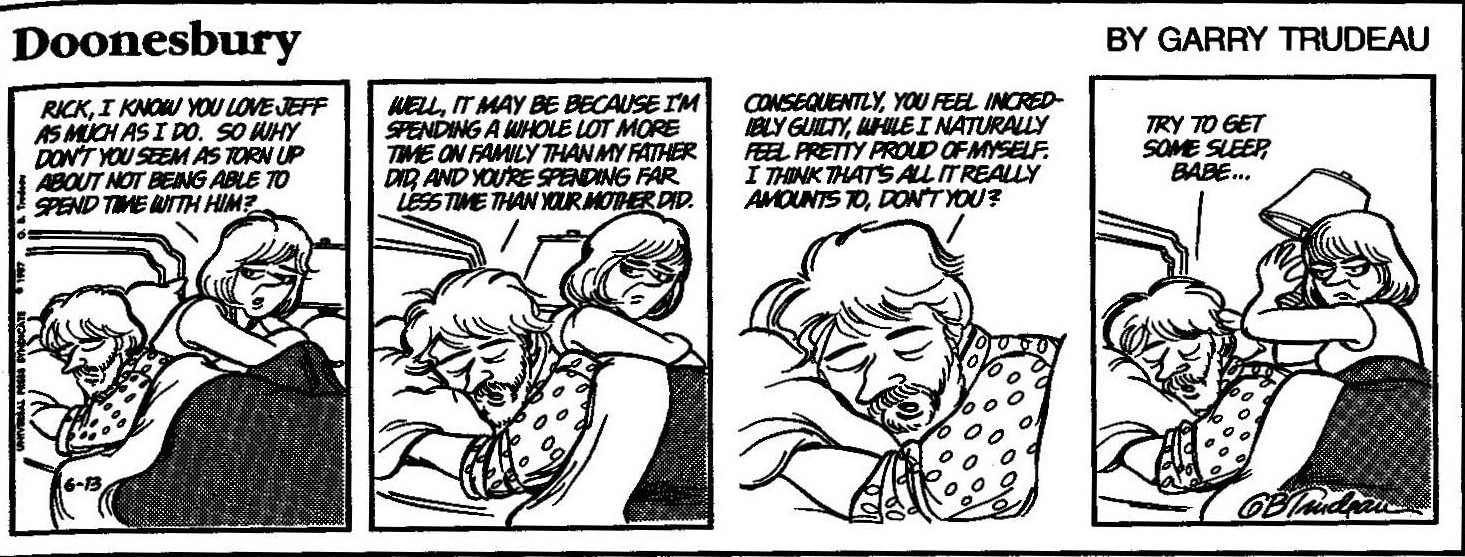
Source: Joan Williams. 2001. Unbending Gender: Why Family and Work Conflict and What To Do About It. New York: Oxford University Press (p. 125).
Week 9 (Mar. 20-23): The Opt-Out Revolution?
Leslie Stahl (correspondent), "Staying at Home," 60 Minutes, July 16, 2005. (movie clip shown in class)
Lisa Belkin. 2003. "The Opt-Out Revolution" New York Times, October 26.
Louise Story. 2005. "Many Women at Elite Colleges Set Career Path to Motherhood." New York Times, September 20.
Heather Boushey. 2005. "Are Women Opting Out? Debunking the Myth." Center for Economic and Policy Research. Washington, D.C. Briefing Paper, November.
Pamela Stone and Meg Lovejoy. 2004. "Fast-Track Women and the "Choice" to Stay Home." The Annals of the American Academy of Political and Social Science 596:62-83.
Karen Albright and Dalton Conley. 2005. "The Effect of Maternal Labor Market Participation on Adult Siblings' Outcomes: Does Having a Working Mother Lead to Increased Gender Equality in the Family?" Revised version forthcoming, Journal of Marriage and Family.
Terry Martin Hekker. 2006. "Paradise Lost (Domestic Division). New York Times, January 1.
Mini debate: Linda Hirshman. 2005. "Homeward Bound." The American Prospect, November 21. vs. David Brooks. 2006. "The Year of Domesticity." New York Times, January 1.
Recommended:
Deborah Carr. 2004. "'My Daughter Has a Career; I Just Raised Babies': The Psychological Consequences of Women's Intergenerational Social Comparisons." Social Psychology Quarterly 67:132-54.
Deborah Carr. 2005. "The Psychological Consequences of Midlife Men's Social Comparisons With Their Young Adult Sons." Journal of Marriage and Family 67:240-50.
Anita Garey. 2006. "Motherhood on the Night Shift." Pp. 532-47 in Amy S. Wharton (ed.), Working in America: Continuity, Conflict, and Change. New York: McGraw Hill. This was drawn from Anita Garey's book (1999. Weaving Work and Motherhood. Philadelphia, PA: Temple University Press), which I also highly recommend.
Jane Gross. 2005. "Forget the Career. My Parents Need Me at Home." New York Times, November 24.
Families and Work Institute, "Generation and Gender in the Workplace:
An Issue Brief"
(http://familiesandwork.org/eproducts/genandgender.pdf)
Part IV. Explanations and Policymaking
Week 10 (Mar. 27-30): Mechanisms of Inequality
https://implicit.harvard.edu/implicit/ [check out implicit attitudes website' "demonstration"'"Go to demonstration tests"; choose one and bring your results to class]
Malcolm Gladwell. 2005. Blink: The Power of Thinking Without Thinking. New York: Little, Brown and Company. (Chs. Intro, 3, and Conclusion)
Virginia Valian. 1998. "Sex, Schemas, and Success: What's Keeping Women Back?" Academe. September-October: 50-55.
Barbara F. Reskin. 2003. "Including Mechanisms in our Models of Ascriptive Inequality." American Sociological Review 68:1-21.
Laurie A. Rudman and Peter Glick. 2001. "Prescriptive Gender Stereotypes and Backlash toward Agentic Women." Journal of Social Issues 57:743-62.
Devah Pager. 2003. "The Mark of a Criminal Record." American Journal of Sociology 108:937-75.
Recommended:
Patricia A. Roos and Barbara F. Reskin. 1984. "Institutional Factors Contributing to Sex Segregation in the Workplace." Pp. 235-60 in Barbara F. Reskin (ed.), Sex Segregation in the Workplace: Trends, Explanations, Remedies. Washington, D.C.: National Academy Press.
Laurie A. Rudman and Stephen E. Kilianski. 2000. "Implicit and Explicit Attitudes toward Female Authority." Personality and Social Psychology Bulletin 26:1315-28.
Devah Pager and Lincoln Quillian. 2005. "Walking the Talk? What Employers Say Versus What They Do." American Sociological Review 70:355-80.
Laurie A. Rudman, Richard D. Ashmore, and Melvin L. Gary. 2001. "'Unlearning' Automatic Biases: The Malleability of Implicit Prejudice and Stereotypes." Journal of Personality and Social Psychology 81:856-68.
David O. Sears and P.J. Henry. 2003. "The Origins of Symbolic Racism." Journal of Personality and Social Psychology 85:259-75.
The Mind/Brain/Behavior Interfaculty Initiative. 2005. Edge, The Third Culture, The Science of Gender and Science: Pinker vs. Spelke: A Debate, May 16, 2005. [A public discussion on sex differences between men and women and how they relate to the careers of women in science.] [http://www.edge.org/3rd_culture/debate05/debate05_index.html]
Kenji Yoshino. 2006. "The Pressure to Cover." New York Times Magazine, January 15.
Week 11 (April 3-6): Debate: Family vs. Village? The Role of Government in Family Policy
Choose one book to prepare for debate (we will do in class):
Hillary Rodham Clinton. 1996. It Takes a Village: And Other Lessons Children Teach Us. New York: Simon and Schuster.
OR
Rick Santorum. 2005. It Takes a Family: Conservatism and the Common Good. Wilmington, DE: ISI Books.
Week 12 (April 10-13): Work, Family, and Community
Robert D. Putnam. 1995. "Bowling Alone: America's Declining Social Capital." Journal of Democracy 6 (January):65-78.
Robert Wuthnow. 2005. "Civil Society: Changing from Tight to Loose Connections." Pp. 63-85 in Jody Heymann and Christopher Beem (eds.), Unfinished Work: Building Equality and Democracy in an Era of Working Families. New York: New Press.
Patricia Roos, Mary Trigg, and Mary Hartman. 2006. "Changing Families/Changing Communities: Work, Family, and Community in Transition." Community, Work & Family 9 (May):197-224.
Ann Bookman. 2004. Starting in Our Own Backyards: How Working Families Can Build Community and Survive the New Economy. New York: Routledge. (Chs. Intro, 1, 10)
Recommended:
Erin L. Kelley. 2003. "The Strange History of Employer-Sponsored Childcare: Interested Actors, Uncertainty, and the Transformation of Law in Organizational Fields." American Journal of Sociology 109:606-49.
Robert Wuthnow. 2005. "Democratic Renewal and Cultural Inertia: Why Our Best Efforts Fall Short." Sociological Forum 20:343-67.
Robert D. Putnam. 2000. Bowling Alone: The Collapse and Revival of American Community. New York: Simon and Schuster.
Week 13 (April 17-20): Work-Family Policies
Jody Miller and Matt Miller. 2005. "Get a Life." Fortune, November 16.
Phyllis Moen and Patricia Roehling. 2005. The Career Mystique: Cracks in the American Dream. New York: Rowman & Littlefield Publishers. (Chs. 7-8 only)
Paul Krugman. 2005. "French Family Values." New York Times, July 29.
Arlie Hochschild. 2006. "The Time Bind: Men." Pp. 522-31 in Amy S. Wharton (ed.), Working in America: Continuity, Conflict, and Change. New York: McGraw Hill.
Jon Gertner. 2006. "What is a Living Wage?" New York Times, January 15.
Corporate Voices for Working Families. 2005. Model Workplace Supports for Lower-Wage Employees. Washington, D.C.
Recommended:
Annette Bernhardt, Martina Morris, Mark S. Handcock, and Marc A. Scott. 2001. Divergent Paths: Economic Mobility in the New American Labor Market. New York: Russell Sage Foundation. (Ch. 8)
Janet C. Gornick and Marcia K. Meyers. 2005. "Supporting a Dual-Earner/Dual-Carer Society. Pp. 371-408 in Jody Heymann and Christopher Beem (eds.), Unfinished Work: Building Equality and Democracy in an Era of Working Families. New York: The New Press.
Sheila B. Kamerman. 2005. "Europe Advanced While the United States Lagged." Pp. 309-347 in Jody Heymann and Christopher Beem (eds.), Unfinished Work: Building Equality and Democracy in an Era of Working Families. New York: The New Press.
Nancy Folbre. 2005. "Eliminating Economic Penalties on Caregivers." Pp. 348-371 in Jody Heymann and Christopher Beem (eds.), Unfinished Work: Building Equality and Democracy in an Era of Working Families. New York: The New Press.
Week 14 (April 24-27): Student presentations
Week 15 (May 1): Student presentations
VI. Help on Research, Thinking, and
Writing:
Becker, Howard S. 1998. Tricks of the Trade: How to Think About Your Research While You're Doing It. Chicago: University of Chicago Press.
Becker, Howard S. 1986. Writing for Social Scientists: How to Start and Finish Your Thesis, Book, or Article. Chicago: University of Chicago Press.
Clarke, Lee. "Notes on Proposing" and "On Writing and Criticism"
Germano, William. 2005. "Passive Is Spoken Here." Chronicle of Higher Education, April 22, 2005.
Jasper, James. "Why So Many Academics are Lousy Writers"
Miller, Jane E. 2004. The Chicago Guide to Writing About Numbers. Chicago: University of Chicago Press.
Miller, Jane E. 2005. The Chicago Guide to Writing About Multivariate Analysis. Chicago: University of Chicago Press. [this encompasses Miller, 2004]
Rosenfield, Sarah. "Some Things To Think About While Reading Papers"
Strunk, William Jr., and E.B. White. 2000. The Elements of Style, Fourth Edition. New York: Allyn & Bacon.
American Sociological Association, "Writing an Informative Abstract"
And, for some humor: "How to Write Good"